
The Mural on the Pines: "Into the Storm" at Wells Christmas Tree Farm
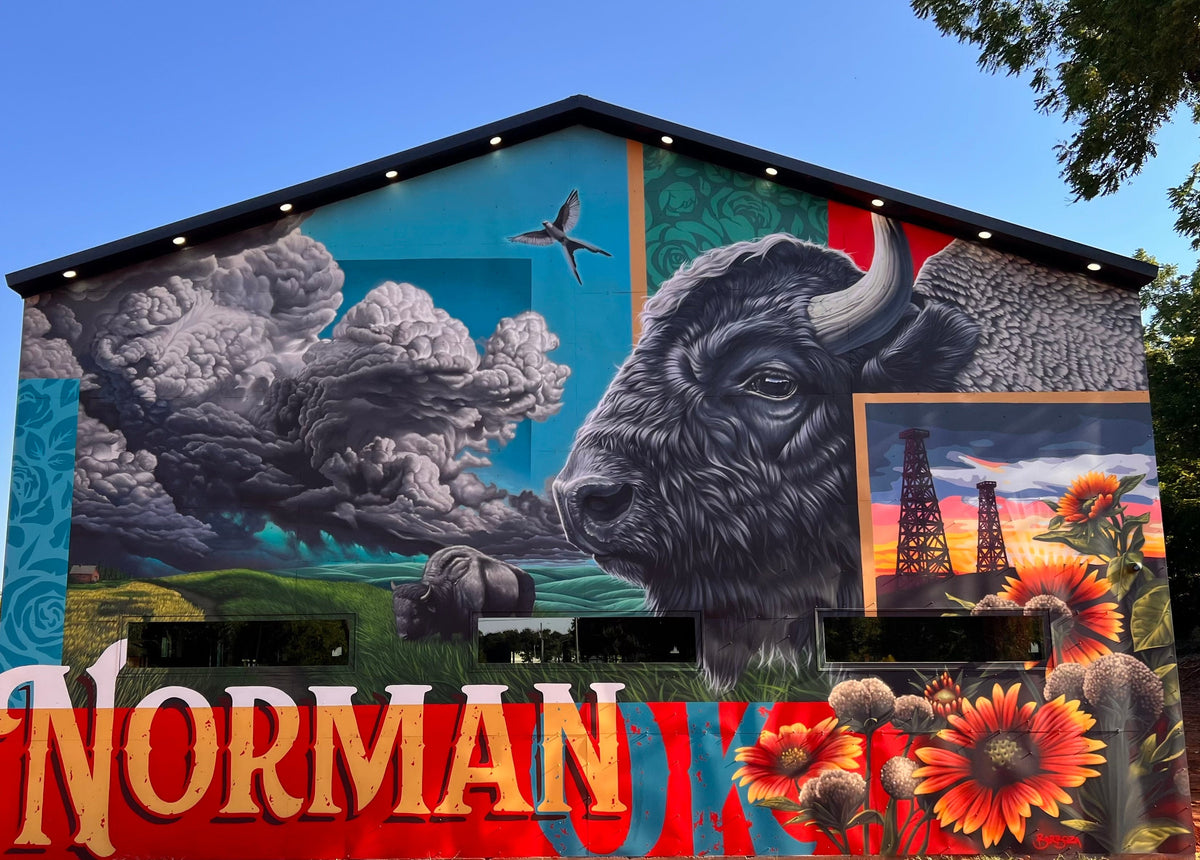
Drive up to Wells Christmas Tree Farm and the first thing that stops you isn't a tree. It's the side of the Pines — a two-story bison turning to face a wall of storm clouds, painted in exacting, almost photographic detail, with "NORMAN OK" spelled out across the bottom in letters the size of a person.
It's called Into the Storm, and it was painted by Carlos Barboza, one of Oklahoma City's most sought-after muralists.
The artist
Barboza was born and raised in San Jose, Costa Rica, in a family of designers, architects, painters, and cartoonists — art was never a question, just a given. He painted his first mural in 2019, and it changed the direction of his whole career. Since then he's painted more than 50 murals around the country, co-founded the Canopy Art Center in OKC's Plaza District, and built a style that blends hyperrealism with surrealist touches — the kind of work where an animal's eye looks wet and real from ten feet away, and the sky behind it is doing something a real sky couldn't.
What it's actually depicting
Nothing on the mural is there by accident.
The bison are turning into the storm, not running from it — that's deliberate. It's how bison actually behave, and it's the whole point of the piece: resilience, the refusal to run, and staying in the herd where everyone protects each other. It's a fair description of Oklahoma weather, and honestly, of the people who live through it every spring.
The composition itself is a compressed Oklahoma sky — sunrise breaking in the east on one side, the storm rolling in from the west on the other, the whole state's weather in one frame. Worked into the scene: a scissortail flycatcher (Oklahoma's state bird), Indian blanket flowers and roses standing in for rose rocks (Oklahoma's state wildflower and state rock), and a set of oil derricks at sunset — a nod to the industry that, for this family specifically, helped fund getting the farm started in the first place.
The Indian blanket flowers aren't just symbolic, either — they grow wild on the farm naturally, along with the rose rocks in the ground beneath them.
Funded in part by the city
The mural wasn't just a private commission — the Norman Arts Council provided a grant to help offset the cost, which is part of why it carries the city's name across the bottom as plainly as it does. It's not a farm logo. It's Norman's.
You can see it any time the farm is open — it's on the Pines facing the entry, not tucked away, and it's become one of the most-photographed spots on the property.