

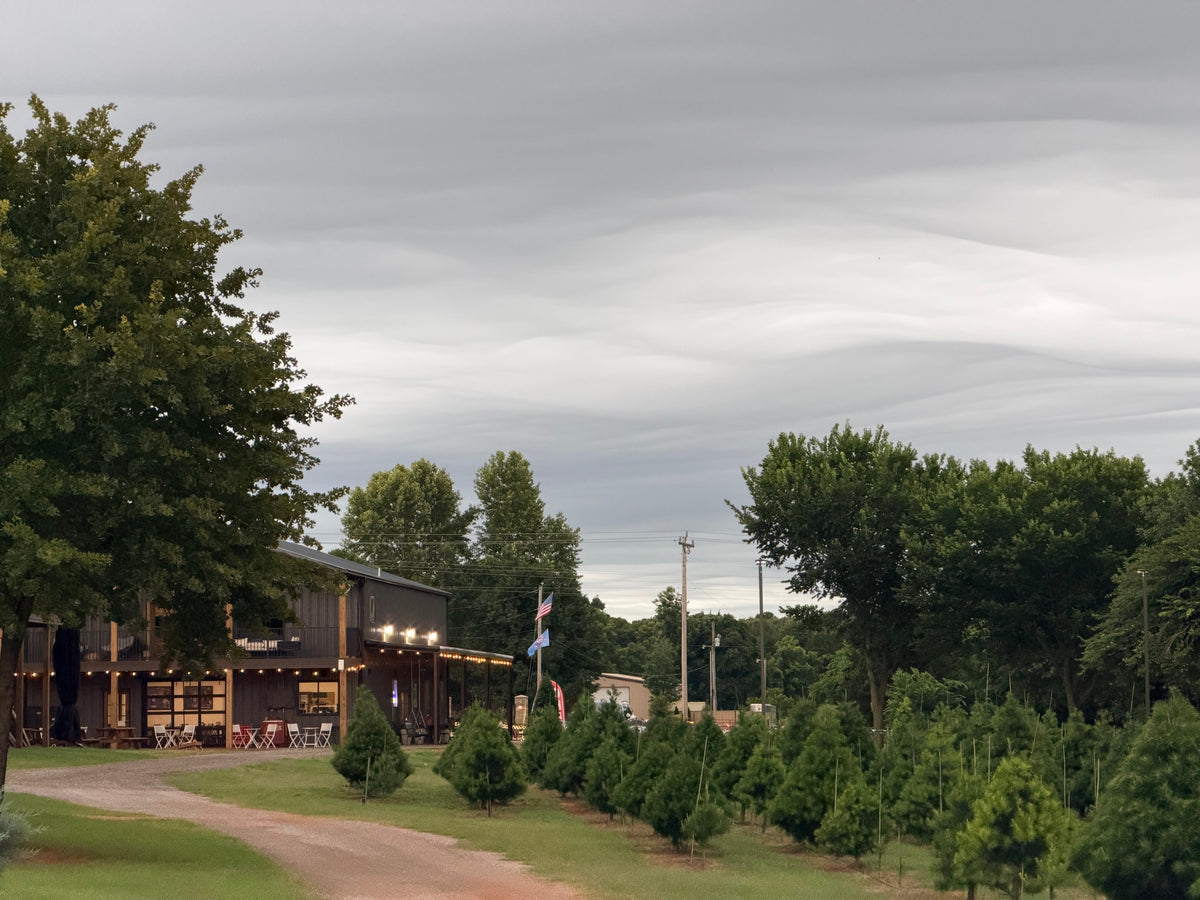
We had a television crew out here in August. KOCO 5 sent meteorologist Joseph Neubauer down to walk the rows and ask how the heat was treating the trees. Fair question. It was the kind of August where you quit checking the forecast because you already know.
Here's the honest answer, and then the part that's actually useful to you: what we do to keep a field of Virginia Pines alive through an Oklahoma drought, and what you can do for the trees in your own yard.
What this summer actually was
Statewide, August 2026 came in as the third-warmest and fifth-driest August on the books going back to 1895 — the Oklahoma Mesonet logged 0.85 inches of rain for the month, about two and a third inches short. As of the first week of September, the U.S. Drought Monitor had every acre of Oklahoma in moderate drought or worse. Our own numbers matched: across one 16-day window in late August we ran a shortfall around six inches of water, sixteen straight days of triple digits, and 1.8 millimeters of rain — total, on one day. Soil temperature four inches down hit 102 degrees. That's not a stressed root zone. That's an oven.
Why we grow Virginia Pine, and what it costs us
The choose-and-cut trees in our field are Virginia Pines, and that's not a preference. It's the species that will actually live here. Virginia Pine handles heat, poor ground, and the heavy red clay most of Cleveland County sits on. Its seedlings tolerate low soil moisture better than most pines, and once established it puts down roots that carry it through a dry summer without much help from us. A Fraser fir would be dead in that field by its second July — firs want cool nights and mountain drainage, and Oklahoma offers neither.
The trade-off is real and we'll say it out loud: Virginia Pine has stiffer, shorter needles and a more open natural habit than a fir. It takes serious shearing every year to shape it, and it won't hold a heavy ornament the way a Fraser will. What it will do is grow here. That's why our field trees are pines and why we truck in pre-cut firs for the families who want one.
How we water — and what we don't claim to know
The field runs on drip. Two zones, both manual faucets, tape down the rows with an emitter every twelve inches. Nothing fancy. What's changed is how we decide when to turn it on. Instead of watering when it feels hot, we keep a running water balance: reference evapotranspiration — how much water the atmosphere pulled out of the ground that day — minus whatever rain fell, added up day over day. When the number gets big enough, that zone gets a long soak. Rain nets itself out, which is the whole point. "It's 104 out" and "the ground is dry" are different facts, and only one should open a valve.
Two honest limits. That deficit is a reference figure — atmospheric demand, not exactly what a given tree drank. We deliberately don't dress it up with a crop coefficient, because the right number for young conifers under drip isn't settled and a made-up one would look more precise than it is. And our field is one- through five-year-old stock mixed through all forty-odd rows, which don't want the same watering at all. So we size for the young trees — they're the ones that die in a week without water. The mature pines get what's left and live on roots and rain, which is exactly what the species is built for.
For the seedlings the answer turned out to be a long soak roughly weekly rather than a daily sprinkle. Which is the same lesson that applies to your yard.
What to do for your own trees
Water deep, not often
Most people get this backwards. OSU Extension is consistent on it: water deeply and infrequently. A daily fifteen minutes of sprinkler keeps the top inch damp and teaches roots to stay shallow, right where the soil bakes first. One long, slow soak every week or two drives water down where roots can live on it.
Slow matters on clay. Norman ground takes water at its own pace — put it down fast and most of it runs into the street. A hose on a trickle, moved around the tree over an hour or two, beats a sprinkler every time. So does a five-gallon bucket with a nail hole in the bottom.
Water the drip line, not the trunk
The feeder roots that take up water aren't at the trunk. They're spread under and past the outer edge of the canopy — the drip line — in the top foot of soil. Watering the trunk soaks the one part of the tree that least needs it and can invite rot at the collar. Work the ring under the branch tips and a little beyond.
Mulch two to four inches, and keep it off the bark
Two to four inches, per OSU, does more work than anything else you can do in an afternoon: holds moisture, moderates soil temperature, keeps grass from competing for the same water. But pull it back a few inches from the trunk. Mulch against bark stays wet, and wet bark rots and invites borers. Doughnut, not volcano.
Water early, and don't help in the wrong direction
Early morning is best — less lost to evaporation than midday, and foliage dries before dark, which matters for disease. Evening is second-best and still far better than skipping it.
Two things not to do to a stressed tree: don't fertilize and don't prune hard. Both push new growth, and new growth needs more water than the tree can currently find. Save both for a wetter year.
Know what stress looks like on an evergreen
A deciduous tree tells on itself fast: leaves wilt, edges scorch, and it may color up early in August like it's October. You get a warning.
Evergreens are quieter, and that's what makes them dangerous. A stressed pine or spruce goes dull — the green loses its shine and flattens to gray-green. Needles brown from the tip inward, and older inner needles go first while the tips still look fine. Growth tips droop. By the time a whole conifer is visibly brown it's often past saving. Watch for the color going flat, because a needle can't wilt the way a leaf does.
Water in the fall — this is the one people skip
When the heat breaks, everybody stops watering. Don't, not entirely. Trees go into winter on whatever soil moisture is there, and evergreens keep losing water through their needles all winter while frozen ground gives none back. That's winter burn, and it shows up in February on a tree that looked fine in September. A couple of deep soaks in late fall, before the ground freezes, is cheap insurance — most of all on newly planted trees and evergreens, and on anything planted in the last two or three years, which has a root ball rather than a root system and can't go find water yet.
One more piece of this belongs in December rather than September: keeping a cut tree drinking once it is standing in your living room. That is its own short guide, and we will put it up when the season starts.
The long view
A Christmas tree is a six-to-eight year crop. The trees we cut this December went in when different weather was normal, and the seedlings we planted this spring will be somebody's tree in the early 2030s. You're always deciding for a season you can't see yet, and that never shows up on a weather map.
We lost trees this summer. Every grower in the state did. But the field is standing, the pines are the right species for this ground, and we'll be open. If you've got a tree in your yard you're worried about, come find one of us — we're usually somewhere between the rows and the coffee shop, and we'll talk trees with anybody.
Slow down on the farm.
Wells Christmas Tree Farm is at 4091 E Franklin Rd in Norman. The Pines Coffee Shop & Event Center is open year-round.